
Table Of Content
Table of Contents
We’ve all been there: sitting at a desk late at night, highlighting paragraph after paragraph of a textbook, or repeating a person’s name ten times in our head, only to completely forget everything five minutes later.
It feels frustrating, but the problem isn’t your brain’s hardware. It’s the software you’re using to store the data.
Most traditional study methods—like rereading notes, highlighting, or brute-force cramming—rely on passive absorption. Your brain is wired to discard information it deems unnecessary for immediate survival. To memorize anything fast and keep it long-term, you need techniques that signal to your brain: this matters, keep it.
Here is a practical, evidence-backed breakdown of how to train your mind to absorb and recall information faster.
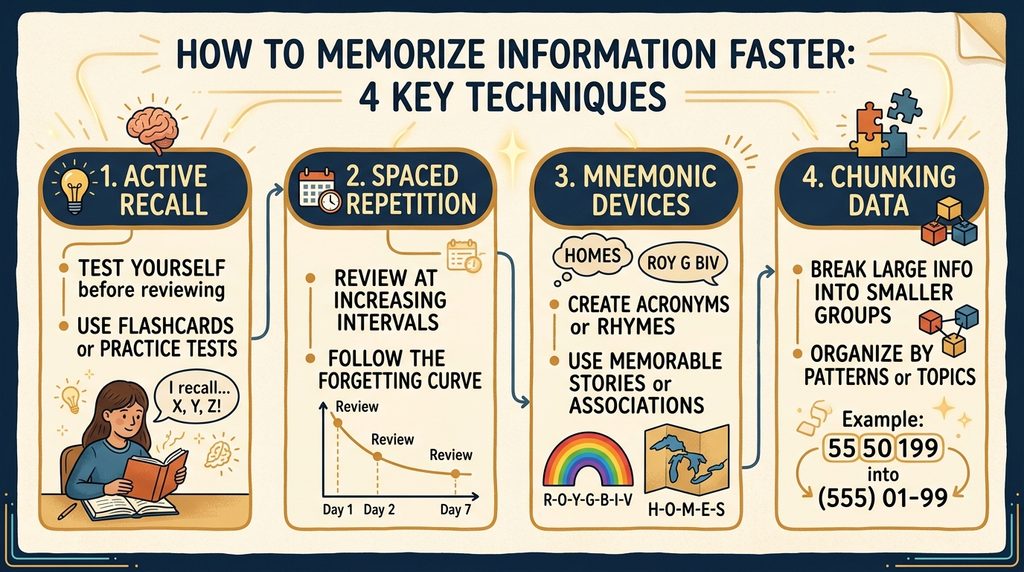
1. Stop Reading, Start Retrieval (Active Recall)
Rereading a chapter creates an illusion of competence. Because the material looks familiar on the page, your brain tricks you into thinking you’ve learned it. In reality, recognition is not recall.
Active Recall forces your brain to retrieve information from memory without looking at the source. Every time your brain works to pull a fact out of storage, the neural pathways associated with that memory strengthen dramatically.
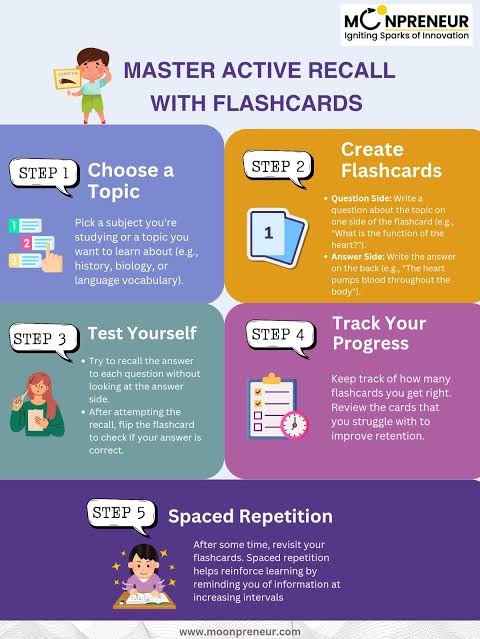
How to Apply It:
- The Blurting Method: Read a single page or concept once. Close the book, grab a blank piece of paper, and write down every single thing you remember without looking. Open the book again to see what you missed—those gaps are your exact weak spots.
- Flashcards (The Right Way): Instead of writing long paragraphs on the back of cards, write one tight question per card. Force yourself to say or write the answer before flipping it over.
Real-World Evidence: In a study published by researchers Henry Roediger and Jeffrey Karpicke, students who used retrieval practice remembered roughly 50% more material a week later compared to students who spent double the time repeatedly reading the text.
2. Flatten the Forgetting Curve with Spaced Repetition
In the late 19th century, German psychologist Hermann Ebbinghaus discovered that humans forget roughly 50% to 70% of new information within 24 hours unless it is reviewed. This steep decline is known as the Ebbinghaus Forgetting Curve.
Cramming for eight hours straight before an exam fills your short-term buffer, but without strategic pauses, that information vanishes almost immediately afterward.
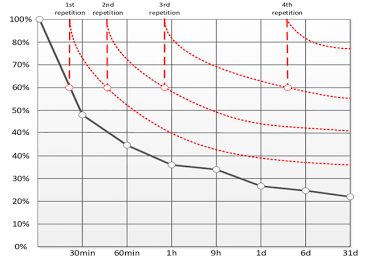
The Solution:
Instead of spending 5 hours studying a topic on Monday, split that time into 30-minute blocks spread across two weeks. Each time you review material just as you are about to forget it, you force your brain to rebuild the memory trace, making it decay much slower next time.
- Day 1: Initial learning + first active recall session.
- Day 2: Quick 10-minute review.
- Day 7: Active testing session.
- Day 14: Final review/self-test.
Software like Anki or RemNote automates this schedule using algorithms that show you cards right when your brain is on the verge of forgetting them.
3. Build a “Memory Palace” (The Method of Loci)
If you need to memorize ordered lists, speeches, historical timelines, or anatomical structures, abstract words are your enemy. Spatial layout, however, is built directly into our evolutionary hardware. Ancient Greek and Roman orators used the Method of Loci (or Memory Palace) to deliver hours-long speeches entirely from memory.
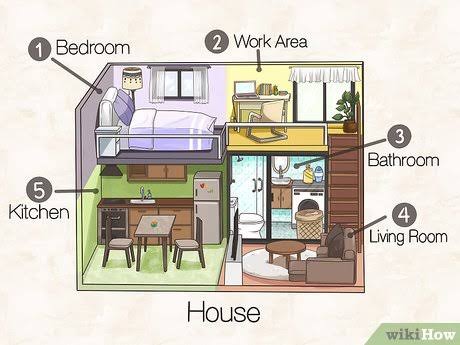
How to Build One:
- Choose a familiar location: Use your house, your daily commute, or your childhood school.
- Define a clear route: Walk through it mentally in a set sequence (e.g., front door → hallway table → kitchen sink → dining table).
- Anchor visual images to locations: Place exaggerated, bizarre visual representations of what you need to remember at each spot.
Example:
To memorize a grocery list (eggs, coffee, batteries, apples):
- Imagine your front door dripping with broken egg yolks.
- Walk into the hallway and step into a deep pool of hot black coffee.
- Look at the kitchen sink: giant, glowing AA batteries are shooting sparks out of the faucet.
- On the dining table, picture a giant green apple wearing a top hat.
The weirder and more emotional the visual imagery, the faster your brain locks it in.
4. Translate Ideas Using the Feynman Technique
Grandmaster memory isn’t just about raw storage; it’s about conceptual hooks. If you don’t understand an idea, memorizing it takes five times longer and crumbles under test anxiety.
Named after Nobel Prize-winning physicist Richard Feynman, this framework tests whether you truly grasp a concept or just know the jargon:
- Pick a concept you’re struggling to memorize (e.g., How photosynthesis works or The Law of Supply and Demand).
- Explain it out loud as if you were teaching a 10-year-old child. Avoid jargon or complex textbook definitions.
- Identify where you stall: The second you hit a gap and resort to saying “it just works like that” or using convoluted terms, stop.
- Go back to the source material, refine your understanding, and simplify the explanation until it flows smoothly.
When you can turn a complex topic into a simple analogy (e.g., “Voltage is like water pressure in a hose, while current is the volume of water flowing through it”), the memory attaches to concepts you already understand.
5. Use Dual Coding and Strategic Interleaving
Dual Coding (Combining Words and Images)
Our brains process visual and verbal information along separate channels. When you pair a text-based fact with a simple visual diagram, you create two distinct retrieval paths in your memory instead of one.
Instead of writing out notes on how the heart pumps blood:
- Draw a rough flow chart with arrows and color codes (blue for deoxygenated, red for oxygenated).
- Even crude, hand-drawn stick figures work dramatically better than block text alone.
Interleaving (Mix Up Your Topics)
Studying one single subject or problem type for four hours straight leads to fatigue and diminished returns (known as “blocking”).
Interleaving involves rotating between 2 or 3 related topics within a single study block. For example, if you are studying math, alternate between algebra problems, geometry concepts, and calculus formulas rather than doing 50 identical algebra problems in a row. This forces your brain to constantly categorize which rule applies when, vastly improving problem-solving speed under pressure.
Frequently Asked Questions
How quickly can I actually see results with these methods?
You will notice immediate improvements in recall accuracy during your very first session using Active Recall and Chunking. However, building a seamless habit with tools like Spaced Repetition or the Memory Palace usually takes about 1 to 2 weeks of consistent practice before it feels natural.
Is cramming ever effective if I have an exam tomorrow morning?
Cramming can push facts into short-term memory long enough to survive a test 8 hours later, but retention drops off a cliff within 24 to 48 hours. If you must cram, skip passive reading entirely: use practice tests and the blurting method to focus 100% of your limited hours on high-yield retrieval.
Does listening to music help or hurt memory retention?
It depends on the music. Instrumental, low-tempo music (like lo-fi or classical) without lyrics generally maintains focus. Music with vocal lyrics or drastic tempo changes triggers your brain’s auditory processing centers, dividing your working memory and reducing intake speed.
Why do I forget people’s names two seconds after meeting them?
This isn’t a memory problem; it’s an attention problem. When introduced to someone, your brain is usually focused on social etiquette or deciding what to say next rather than encoding the name. To fix this: repeat the name out loud immediately (“Great to meet you, Sarah”), and visually associate their face with something distinct for 3 seconds.
Do memory supplements or “brain foods” actually speed up memorization?
No supplement can replace proper study mechanics. While staying hydrated and maintaining healthy omega-3 and Vitamin D levels supports general cognitive function, no pill will help you memorize information faster if your study habit consists of passively highlighting textbooks. Sleep is the single best “brain supplement”—deep Non-REM sleep is when your hippocampus transfers short-term memories into the long-term neocortex.
To memorize faster, shift your effort away from how you put information into your head and focus almost entirely on how you extract it out. Start with active self-testing today, set up a simple spaced schedule, and let your brain’s natural wiring do the heavy lifting.